A visual essay on solitude as passage—how cities manufacture distance, and how landscape undoes it
I had been to Japan before. The first time I travelled there, everything felt like momentum: neon, transit, hunger, the urge to see more than a body can hold. This time, I gave myself more time—and a different kind of attention.
There were mornings I slipped out alone with my camera, not out of restlessness but out of necessity. Something about the way a place reveals itself when you move through it without a destination, without anyone waiting.
Held
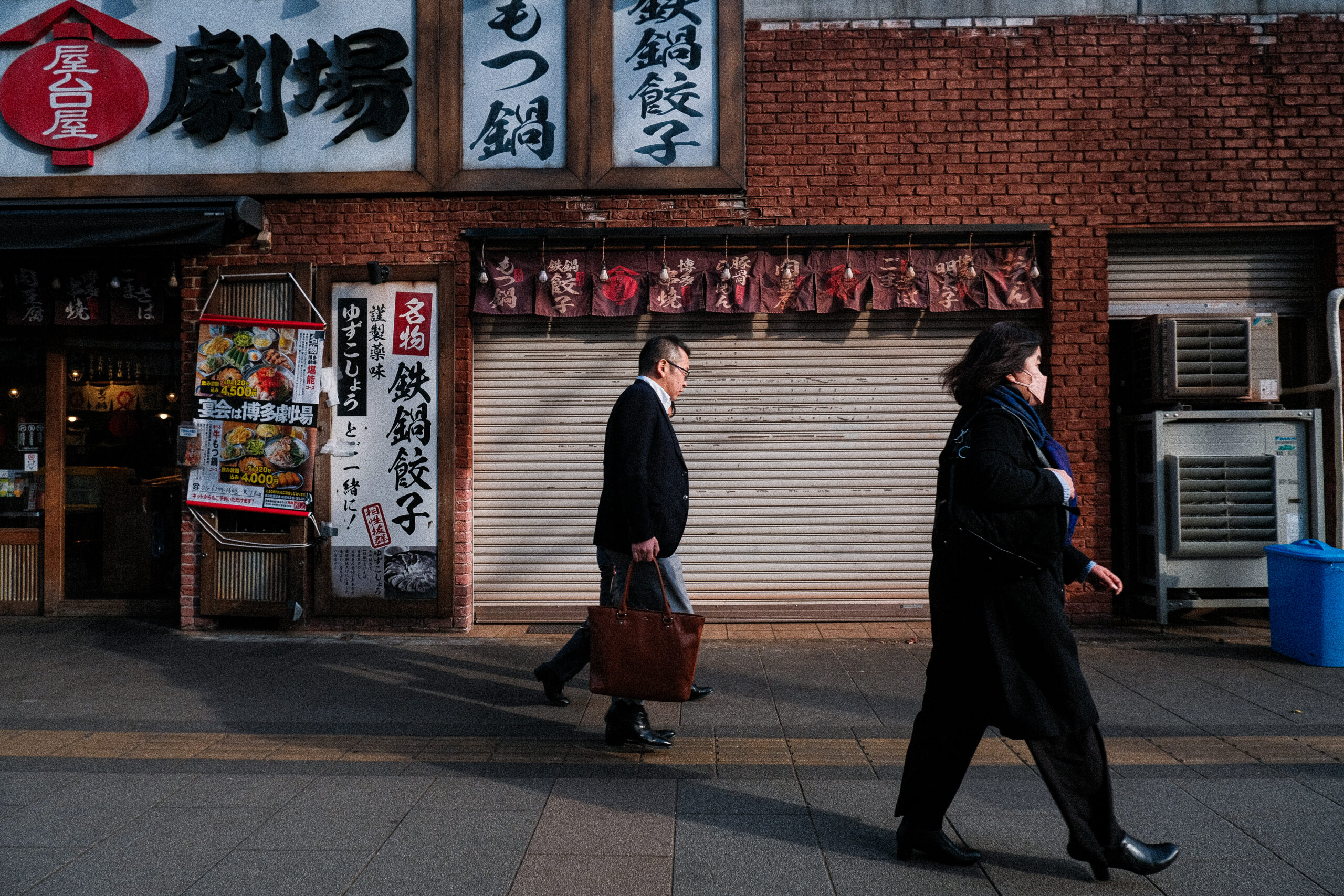
Some cities teach us a particular kind of solitude. Not the absence of people—almost the opposite. It is manufactured inside proximity: strangers sharing the same pavement, the same minute, never quite touching. Japan made this visible to me.
In Tokyo, people pass each other without interacting. What struck me was not their loneliness, but the system they were part of: a city that had designed solitude into its grammar. The frame they occupy is busy with signs, bicycles, vending machines hum, the constant shuffle of commuters, and yet people move through it like figures in separate photographs.
Even when the subject was near, the picture insisted on distance.
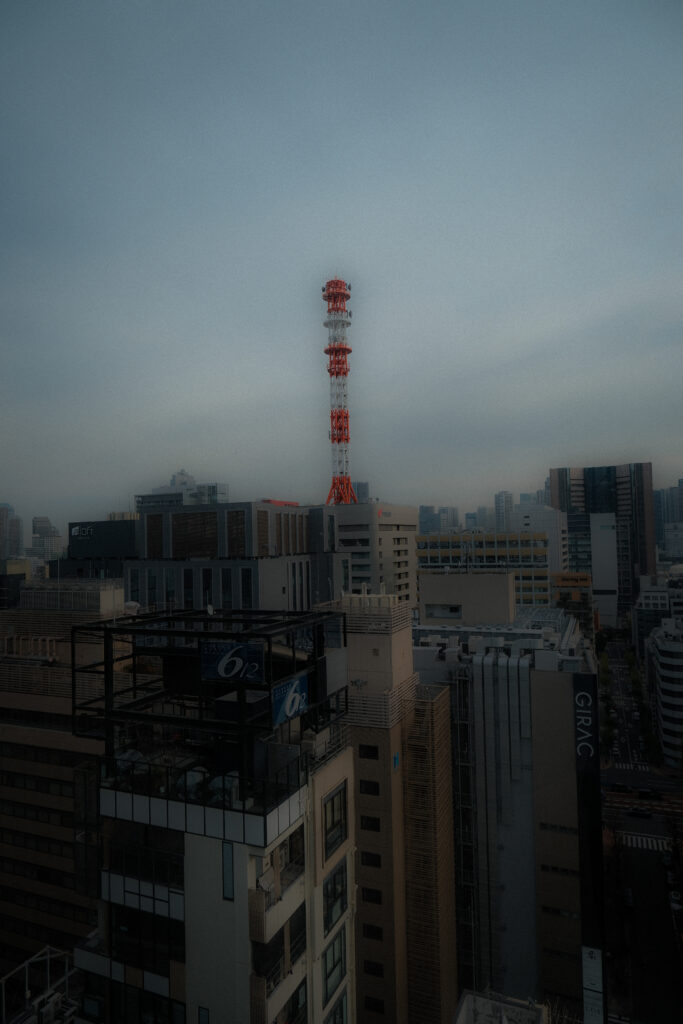
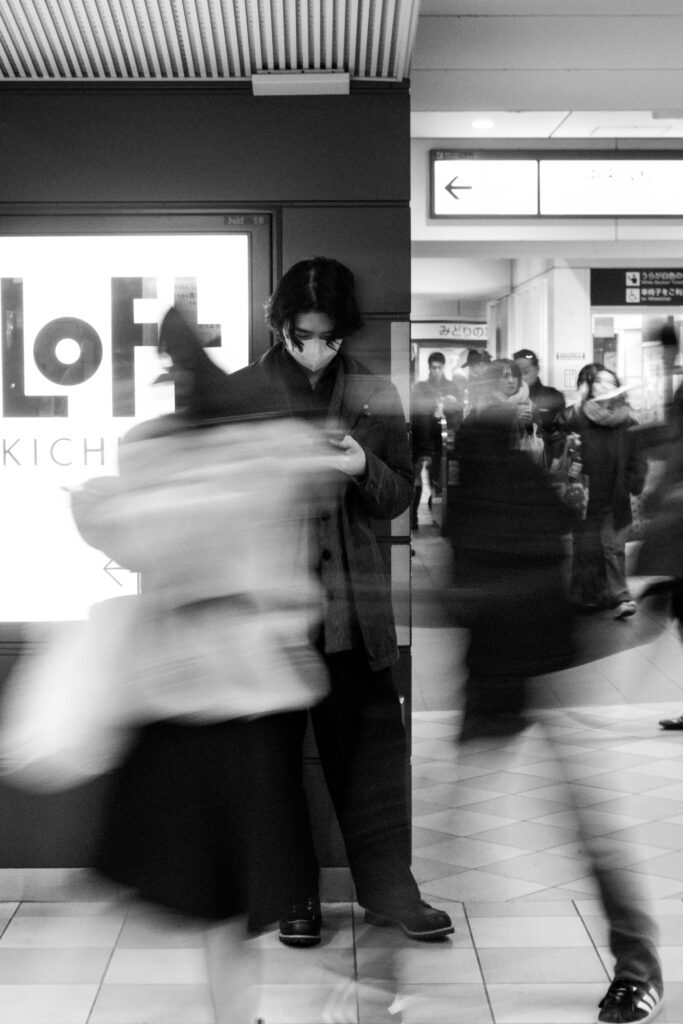
I began to notice that my images had edges inside edges, squares within squares. Even when the subject was near, the picture insisted on distance. At Kichijoji Station, I once stopped to use a long exposure on my camera. The crowd became blur and speed around a young man who stayed still, holding his phone as if it were an anchor. Is stillness in a moving crowd a form of resistance, or simply another kind of container?
I recognized something in him. I’d come to Japan wanting a break, but what surfaced first was a pattern I already knew: I keep my distance, even from what I care about. The camera made that easy—it let me watch instead of be there.
Unbound
Somewhere between the first week in Tokyo and the second, something loosened. It’s hard to name exactly. Maybe it was the simple accumulation of days. Maybe it was leaving the capital—trading timetable urgency for slower places, smaller streets, air that didn’t feel like it was pushing me forward. I only know that my attention changed, and with it, the way I photographed: less the world itself, more the edges of it. Less people, more their traces.
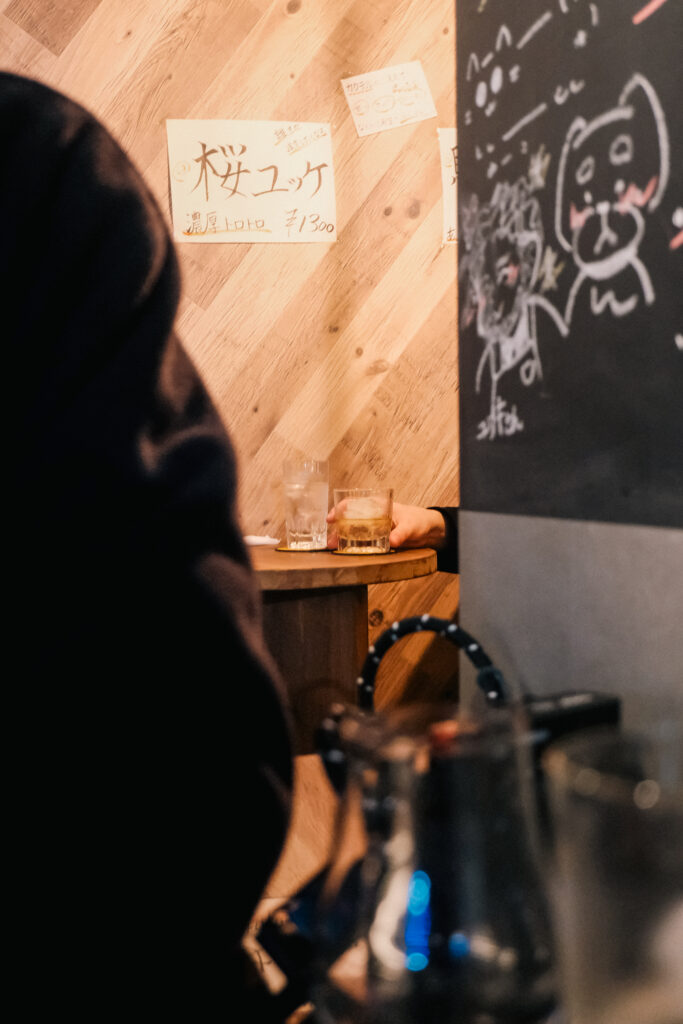
I began paying attention to the small evidence people leave behind rather than the person themselves. In a bar in Fukuoka one evening, I made a photograph I cannot fully explain. A hand holds a whisky glass on a small round shelf. Next to it, a handwritten menu for sakura yukke, a cat doodle left by a person I would never meet. My boyfriend is present in the frame only as the blur of his shoulder. There is something in this picture I keep returning to: the feeling of being in a room so fully that you disappear from it.
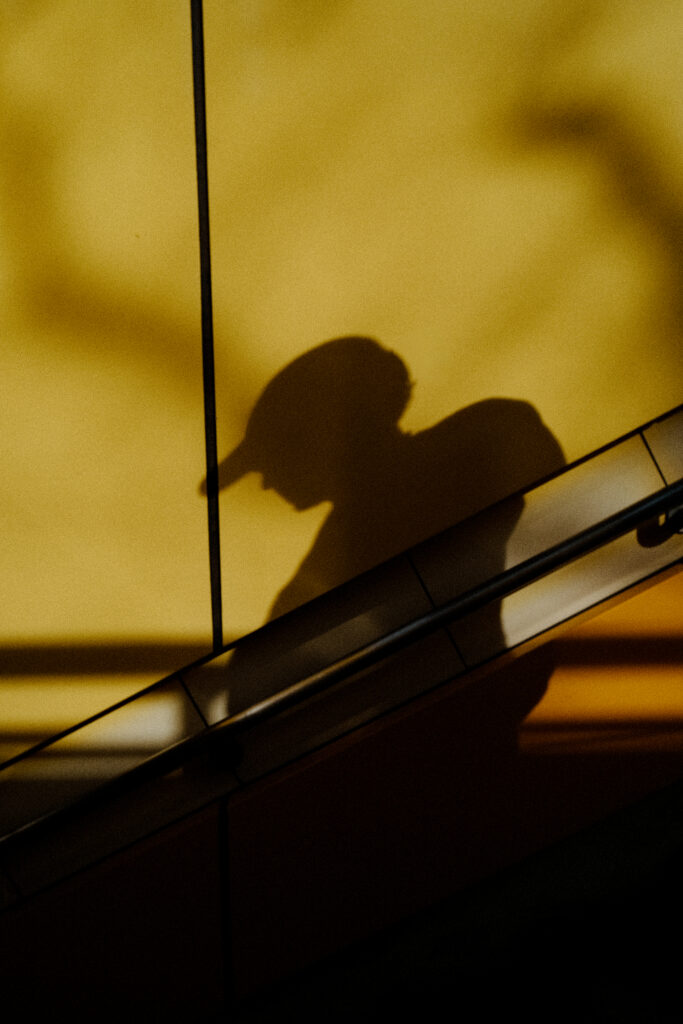
From there, the pictures began to thin out. I was learning to trust what I couldn’t hold. Like this shadow on a yellow wall—the silhouette of a man descending stairs, head bowed, cap on, cast enormous by an angle of sunlight I didn’t plan and couldn’t repeat. The person isn’t even in the frame. Only the projection is. There’s something tender in that: how easily we leave a trace, and how often a photograph ends up being a picture of absence.
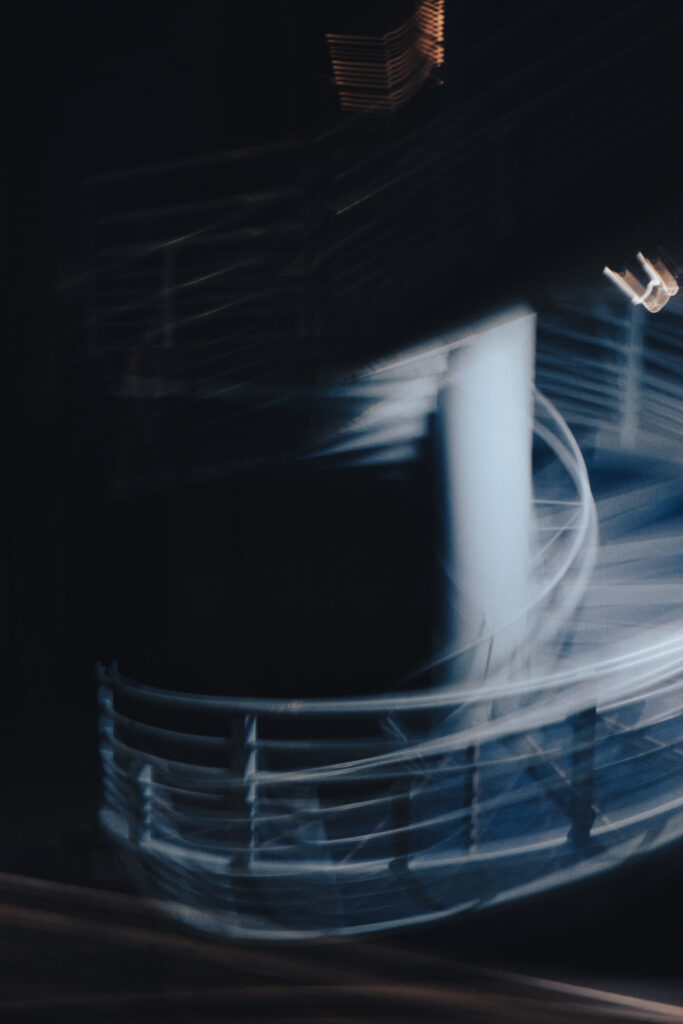
Some images come from patience. Others from letting go. I’d been shooting carefully all day in Aoshima when the light changed and I stopped thinking. Long exposure, my hands turning—the structure broke into streaks, into something like sound. I didn’t know exactly where I was. That was the point.
Widening
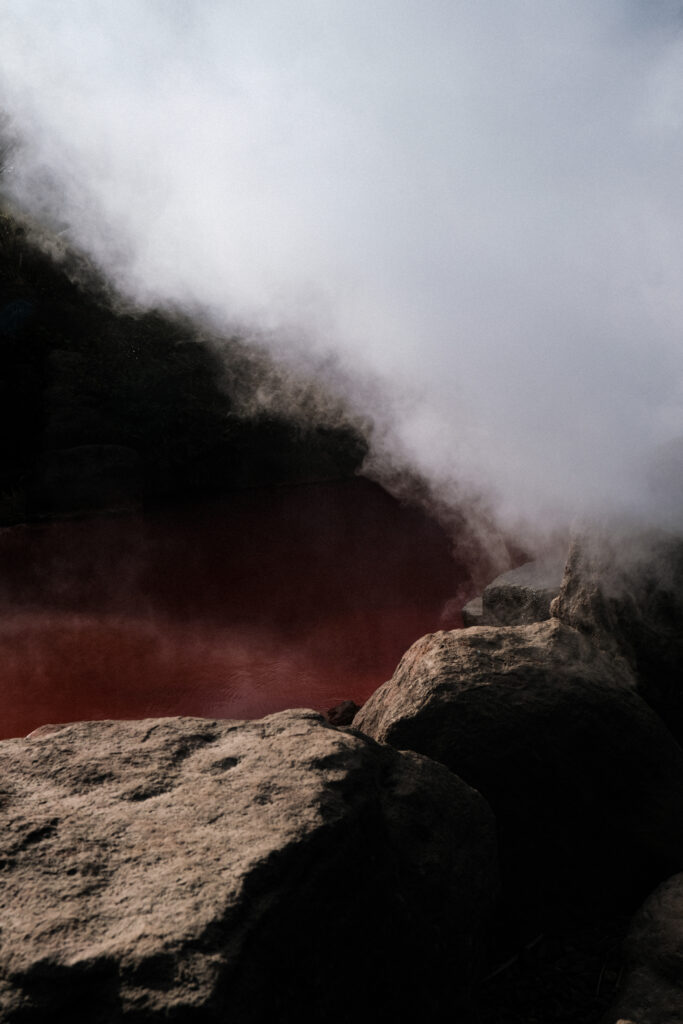
The next destinations in Kyushu changed the scale of everything. In Beppu, at Jigoku—The Hells—the water runs red with iron oxide, steam rises in columns thick enough to walk into, and for a moment you understand the planet as a living system that has been working at this long before cities were invented and will continue long after. Chinoike Jigoku, The Blood Hell: I have no tidy metaphor for it. Ancient, indifferent, beautiful in the way that things are beautiful when they have no interest in being observed.
What drew me wasn’t the spectacle of it, but what happened at its edges. Nearby, workers moved through clouds of geothermal vapour, cooking food in the earth’s heat—each solitary in their task, separated by shifting curtains of steam. And yet there was warmth in it: shared fog, breath made visible in the cold. Solitude and company, I was learning, aren’t opposites. They were sitting right next to each other.
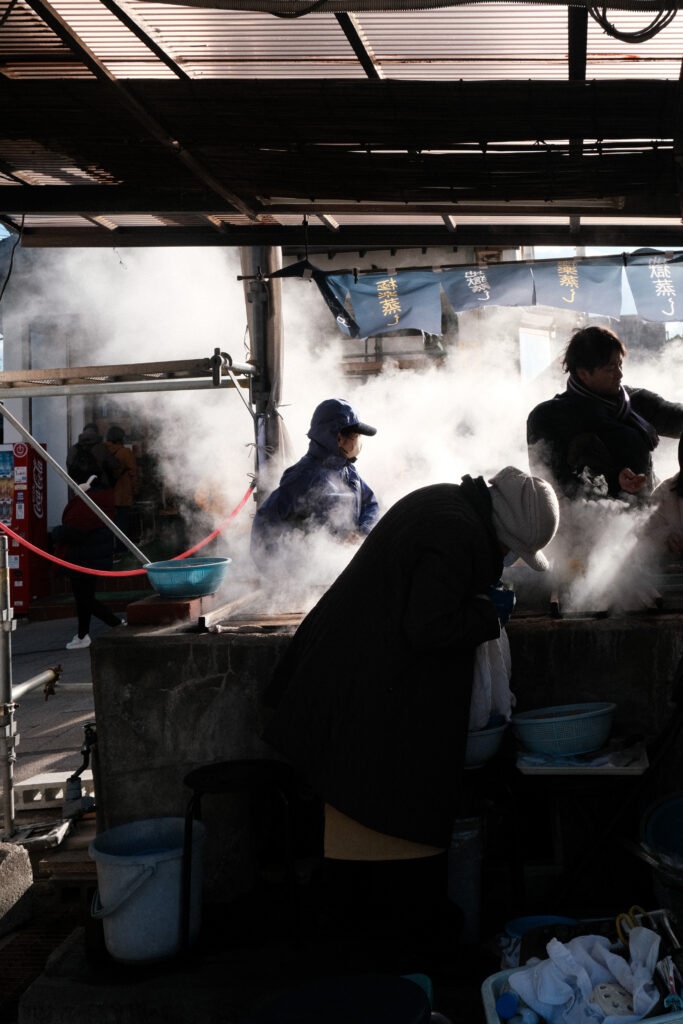
The world was here before you arrived, and does not require your witness to continue existing.
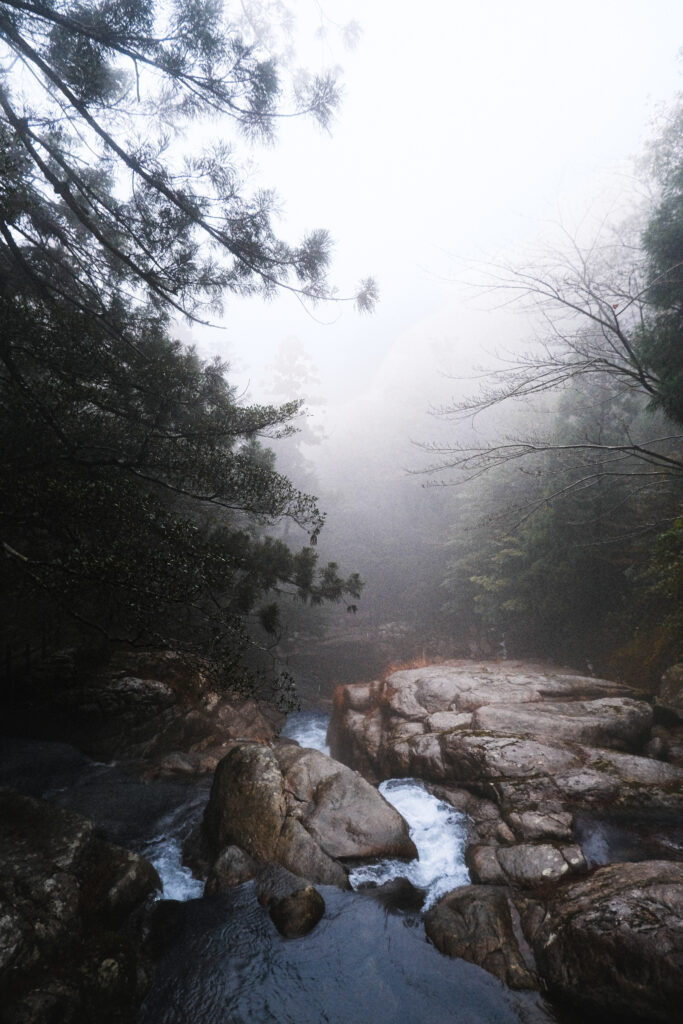
That became clearest in the last place we went, Yakushima. The island feels older than whatever word we have for old. I stood on the bank for a long time and did not photograph it immediately, which almost never happens. Something about the place asked for stillness before it would let itself be seen.
When I finally did raise the camera, I understood something about all the frames that had come before: that solitude, followed long enough, stops being about you. It opens into the fact that the world was here before you arrived, and does not require your witness to continue existing.
I came to Japan for the second time with someone I love, in a country that felt almost like home. What I brought back is this: that solitude is not a problem to be solved.
In Japan—in its cities, its hells, its ancient forests—it is a practice. A system. A way of being present that does not require company to be complete.